Short Inca Trail to Machu Picchu 2 day
Activity Type
Hiking Adventure
Overview
This 2-day Inca Trail tour is the ultimate excursion for anyone craving a taste of this legendary journey but is short on time. It’s an ideal option for those who don’t want to miss out on a unique experience. This route carves through a stunning rainforest landscape, teeming with a thriving variety of flora and fauna. You’ll also get your history fix at the archaeological sites of Chachabamba and Wiñay Wayna (Forever Young), all while covering a distance of 12 km (7.4 miles). The best part? You’ll get to experience Machu Picchu twice, which is a major win. This gives you the chance to capture photos at both sunset and sunrise, making the whole thing feel even more epic.
The 2-day Inca Trail lets you see incredible ruins like Chachabamba and Wiñaywayna. You’ll also get to walk through the Sun Gate on foot, just like the Incas did. After you’ve passed through the Machu Picchu park, you’ll take a bus down to the town of Aguas Calientes. There, you can enjoy an unforgettable dinner at a charming and chic restaurant before calling it a night. The next day, you’ll have a private guided tour of Machu Picchu that’s sure to blow your mind.
Itinerary
We’ll kick things off with an early departure from Cusco at 4:00 a.m. to start our 2-day hike. We’ll travel by car for about 1 hour and 30 minutes to Ollantaytambo (9,160 ft / 2,792 m), where we’ll grab a quick breakfast. From there, we’ll hop on a train to Kilometer 104, which is where the trail starts. Today’s trek will take us along the most beautiful part of the classic 4-day Inca Trail. We’ll visit stunning Inca sites, see an abundance of vibrant flora and fauna, and soak in the breathtaking views of the Andes.
Our hike begins in the Sacred Valley and ascends along an authentic Inca stone-paved path to the archaeological site of Wiñay Wayna. After exploring Wiñay Wayna, we’ll have a picnic lunch with an incredible mountain view. Once we’ve refueled, we’ll walk through the verdant cloud forest that blankets the mountain, spotting a vast variety of plants, flowers, orchids, and birds along the way.
After a full day of hiking, we’ll arrive at the iconic Sun Gate, where you’ll get your first glimpse of Machu Picchu, sprawled across the mountain ridge. From there, we’ll walk for about 45 more minutes until we reach Machu Picchu itself. We’ll explore the upper section of the site, following Circuit 01, which is where you can snap that famous postcard photo. Then, we’ll take a bus down to Aguas Calientes (6,692 ft / 2,040 m), arriving around 5:00 p.m. Once we’re there, the guide will help you check into your hotel. You’ll have some free time before dinner to visit the town’s hot springs for a relaxing soak. After a delicious dinner, you’ll head back to the hotel for a well-deserved rest.
- Altitude Gain: 1,683 ft / 695 m
- Altitude Loss: 820 ft / 391 m
- Highlights: Trek on the original Inca Trail, visit the ruins of Wiñay Wayna
- Hiking Distance: 6.83 miles / 11 km
- Trailhead Altitude: 6,561 ft / 2,000 m
- Highest Point: 8,923 ft / 2,720 m
- Weather: Hot and humid
Day two is the absolute pinnacle of the trip: visiting Machu Picchu (7,972 ft / 2,430 m). Your guide will meet you at your hotel, and you’ll walk together to the bus station to catch the first bus at 5:30 a.m. The bus ride takes about 30 minutes.
At the entrance, you’ll need to show your passport and entry ticket. Once inside, your guide will take you to one of the best spots for a photo of the citadel. Then, you’ll explore Machu Picchu following Circuit 03. For about 2 to 3 hours, your guide will show you all the iconic landmarks, including the Temple of the Sun, the Inca houses, the water fountains, the agricultural terraces, the Sacred Rock, the Temple of the Condor, and the warehouse.
After the tour, you’ll head back to Aguas Calientes for lunch. Once you’ve finished eating, your guide will take you to the train station for your return trip to Ollantaytambo. From there, a driver will pick you up and take you back to your hotel in Cusco, arriving around 7:30 p.m.
If you book an additional hike to Huayna Picchu or Machu Picchu Mountain, your guide will help you find the trailhead and give you all the safety tips you need. They will also provide you with the bus ticket to get back to Aguas Calientes. The trail to these mountains is unique and well-marked. Just know that you’ll do this extra hike on your own. If you want a guide for this part, there will be an extra charge, so let us know if you need one.
- Highlight: Early morning visit to Machu Picchu to catch the sunrise over the Citadel
- Weather: Warm and humid
- Meals: Breakfast is the only meal included
- Aguas Calientes Altitude (where you’ll sleep): 6,692 ft / 2,040 m
- Machu Picchu Altitude: 7,972 ft / 2,430 m
Inclusions
Included
- Professional Guides: Our guides are deeply knowledgeable about the history, geology, and archaeology of the Peruvian region we explore, and they speak fluent Spanish.
- Informative Briefing: The night before your hike (usually at 6:00 p.m.), you’ll attend a meeting at our office with your guide and the rest of your group.
- 3-Star Hotel: We reserve the Tara Machu Picchu or a similar 3-star hotel.
- Satellite Phone: Our guides always carry a satellite phone for contacting hospitals, doctors, and coordinating emergency rescues if necessary.
- Hotel Pick-Up and Drop-Off: We’ll pick you up from your hotel or Airbnb in Cusco and drop you back off after your adventure.
- Private Transportation from Cusco to Ollantaytambo: Our drivers will take you in our private tourist bus from your pick-up point to Ollantaytambo, where you’ll catch your train.
- Chefs: Our chef will prepare a delicious picnic lunch for you at the Wiñaywayna camp.
- Picnic Tent with Chairs and Tables: We provide a large picnic tent with chairs and a table for you to enjoy your meal in comfort.
- 2 Breakfasts: The first breakfast is at a restaurant in Ollantaytambo. The second is provided by the hotel before you head to Machu Picchu.
- 3 Bus Tickets: On day one, you’ll take a bus down to Aguas Calientes after your hike. On day two, you’ll take a bus to Machu Picchu and another one back down to Aguas Calientes after your tour.
- Inca Trail Permit: The tour cost includes the entrance fee and access to the various attractions along the trail.
- Picnic Lunch: We are the only providers who offer a full picnic lunch, so you can eat amidst the stunning scenery of the short Inca Trail. We offer a variety of dishes, including proteins, salads, sides, and desserts, and can accommodate vegetarian, gluten-free, lactose-free, and other dietary needs.
- Dinner: We provide a dinner for you at a restaurant in Aguas Calientes.
- Machu Picchu Entrance: You’ll explore Machu Picchu with our guide, who will show you the most important temples and sites.
- Round-Trip “Expedition” Train Tickets: On day one, you’ll take the 6:10 a.m. train from Ollantaytambo. The next day, your return ticket from Aguas Calientes to Ollantaytambo will be for the 2:55 p.m. or 3:20 p.m. departure.
- Private Transportation from Ollantaytambo to Cusco: Once you get off the train in Ollantaytambo, you’ll board our van to be taken back to Cusco.
- Oxygen Tank: Our guides always carry an oxygen tank for emergencies.
- First Aid Kit: Our guides have a first aid kit with them during the hike.
- Rain Poncho: We provide a plastic rain poncho for extra protection against heavy downpours.
- Guided Machu Picchu Tour: You’ll explore Machu Picchu with our guide, who will show you the most important temples.
- Backpack Cover: We provide a cover to protect your backpack from rain, dust, and dirt.
- Free Luggage Storage: We will store any extra personal belongings you don’t need during your hike.
No Included
- Lunch on the second day.
- Entrance to the hot springs in Aguas Calientes (US$ 5).
- Tips (optional).
Extra Services
| Service |
Price |
Note |
| Huayna Picchu Mountain |
$65 |
Prices may vary slightly. |
| Machu Picchu Mountain |
$65 |
Prices may vary slightly. |
| Vistadome Train |
$50 |
Prices may vary slightly. |
| Trekking Poles |
$5 |
|
What to Bring
- Passport: You have to bring your physical passport. It will be checked at the Chachabamba checkpoint and when you board the train. Make sure it’s the exact same passport you used to book your Short Inca Trail permits.
- Student ID: If you booked the Short Inca Trail as a student, you must bring your physical student ID.
- Backpack: A 25-liter backpack is a good size. You can bring a smaller or larger one, as there are no restrictions on the Inca Trail. But if your backpack is too big when you visit Machu Picchu, you’ll have to store it in a locker for 5 soles. The locker is secure.
- CamelBak or Water Bottle: You’ll need a water bottle to stay hydrated on the trail. Bring a reusable one, as disposable plastic bottles are not allowed.
- Water: We recommend bringing at least 2 liters of water per person.
- First Aid Kit: It’s always a smart move to bring your own. While our guides have one, they can’t prescribe medication.
- Clothes for Machu Picchu: Since you’ll want to keep your Machu Picchu photos forever, it’s a good idea to pack an extra change of clothes for the trip.
- Swimsuit (optional): Some travelers visit the hot springs in Aguas Calientes.
- Sun Hat: The first part of the trail is exposed to the sun, so you’ll need protection.
- Sandals: After the hike, you can change into sandals for comfort.
- Portable Charger: There are so many stunning places to take photos and videos, so bring a portable charger in case your phone battery dies.
- Towel (optional): The hotel will provide a towel, but you can bring your own if you prefer.
- Trekking Shoes: It is highly recommended to wear trekking shoes. The path is rocky and can be slippery when wet.
- Sunglasses: It’s usually sunny on the Short Inca Trail.
- Sunscreen: The sun’s rays are very strong in the Andes, so don’t forget your sunscreen.
- Insect Repellent: The entire trail is in a rainforest area, so there will be a lot of mosquitoes year-round, especially in August and September.
- Trekking Poles with Rubber Tips: If you’re not used to hiking, poles can be super helpful, especially if you have knee problems.
- Snacks: While snacks are provided, if you tend to eat a lot, you might want to bring your own, like energy bars, cookies, or candies.
- Electrolytes (optional): If you need an energy boost during the hike, electrolytes can help.
- Hand Sanitizer: In some parts of the trail, there might not be water available to wash your hands, so hand sanitizer is essential.
- Toilet Paper: Bathrooms at the Wiñaywayna camp and some points on the trail may not have toilet paper, so it’s a good idea to bring your own.
- Long-Sleeved Shirt: It’s a good idea to bring light, breathable long-sleeved shirts for sun protection and for cooler mornings or evenings.
- Fleece Jacket or Sweater: A light, warm fleece is essential for cooler temperatures, especially in the mornings and evenings.
- Trekking Pants: We recommend wearing trekking pants, as they dry quickly, unlike jeans, which can make you cold if it rains.
- T-Shirts: Bring at least two t-shirts to change into, as you’ll sweat a lot during the hike.
- Waterproof Jacket: Due to climate changes, it can rain at any time of year, so a waterproof jacket is recommended.
- Camera or Cell Phone: There are so many beautiful places to take photos on the Short Inca Trail and in Machu Picchu.
- Money: If you forget something, you can buy it in Ollantaytambo, but they only accept cash. It’s better to bring Peruvian soles, as the exchange rate for US dollars is not great.
- Moleskin: In case of blisters, moleskin can help treat them.
- Extra Trekking Socks: You’ll need at least two pairs of socks: one for the first day and one for your visit to Machu Picchu.
- Immigration Card: When you check into a hotel in Aguas Calientes, you’ll have to show your immigration card, which you received on the plane when you entered Peru.
- Binoculars (optional): If you love birdwatching, bring binoculars, as there are many species in the area.
Additional Info
Huayna Picchu Mountain
Huayna Picchu, the iconic peak sitting behind Machu Picchu, offers incredible views of the ancient site. We’ll handle the ticket purchase for you, securing your preferred date and time. Only 300 visitors can climb Huayna Picchu daily, so it’s essential to book far in advance. For the 2-day Inca Trail, we schedule your ascent between 10:00 a.m. and 11:00 a.m., after your 2-hour guided tour of Machu Picchu.
The ascent takes about an hour, and the descent takes about 45 minutes, for a total of 2 to 2.5 hours. The trail features notable Inca structures, like terraces and houses, whose original purposes are still being studied. Be warned, though: the climb is steep and challenging in some sections, with parts where you’ll need to use your hands to keep your balance. We don’t recommend it for anyone with a fear of heights or who gets dizzy easily. Get ready for an epic adventure exploring this historical and stunning site.
Machu Picchu Mountain
Machu Picchu Mountain, standing at 3,082 meters above sea level, is located just south of the iconic Inca city. It’s important to understand the difference between the mountain and the historical citadel of Machu Picchu. While the Citadel is the famous archaeological site you see in all the photos, Machu Picchu Mountain is a separate peak that you can hike. Climbing this mountain requires a special ticket, which gives you a truly unique perspective of the landscape and the ancient city from way up high.
Only 250 permits are issued per day: 125 for entry between 7:00 a.m. and 8:00 a.m. and 125 between 9:00 a.m. and 10:00 a.m. For our short Inca Trail tour, we typically secure the second time slot, so you can do the hike after your Citadel tour. Due to the limited availability, booking ahead is a must. The hike usually takes between 3 and 3.5 hours, with about 1.5 hours to go up, 30 minutes at the summit, and an hour to come down. Unlike Huayna Picchu, the trail is wider, less steep, and has authentic Inca stone steps. From the top, you’ll get panoramic views of Machu Picchu, the valleys, the rivers, the mountains, and even the final stretch of the classic 4-day Inca Trail on a clear day.
Note: For your 2-day Inca Trail hike, you can choose to climb either Huayna Picchu Mountain or Machu Picchu Mountain. You can only visit one of these mountains due to time constraints.
Vistadome
Our 2-day Inca Trail trip includes a round-trip ticket on the Expedition train, which is comfortable, clean, and gives you great views of the surrounding scenery. But if you want to elevate your trip, you can upgrade to a Vistadome train ticket for your return journey from Aguas Calientes to Ollantaytambo. The Vistadome train has wider windows, bigger tables, comfier seats, and a glass roof—perfect for soaking in all the incredible mountain views. Plus, they offer entertainment, dance performances, fashion shows, and a complimentary snack.
Note: We don’t offer the Vistadome service for the trip from Ollantaytambo to Km 104 due to time limitations. The earliest Vistadome departure is at 7:05 a.m., which would leave you with less hiking time. We typically book the Expedition train that leaves at 6:10 a.m. to make sure you get to Machu Picchu with plenty of time to catch the bus.
Trekking Poles
Trekking poles are optional, but we highly recommend them, especially if you have knee issues or aren’t an experienced hiker. Even experienced hikers can benefit from using poles; it really comes down to your comfort level and preference. They offer a lot of support and stability during the hike, which can help prevent injury or overexertion.
Note: If you don’t have your own trekking poles, you can rent them from us for $5 for the whole hike. All of our poles are from Black Diamond, a well-known brand for high-quality hiking gear. It’s important to know that walking sticks are not allowed inside the Machu Picchu citadel or on Huayna Picchu Mountain. So, when we get to Machu Picchu, your guide will collect them and store them safely at the hotel in Aguas Calientes for you. The next day, you’ll explore Machu Picchu without them.
Why Choose "Peru Day Tours" for your next adventure

OUR TOUR GUIDES
A highly qualified professional with extensive experience in the art of guiding will lead your tour. They have years of dedication to nature walks, have medical certifications and an overflowing passion for leading people on unforgettable adventures.

OUR CHEFS
We understand how essential a delicious hot meal is to revitalize and comfort your body after a challenging hike. Therefore, on each expedition with Ausangate Peru, you will find chefs with extensive experience in preparing meals during the hikes.

MEALS: WHAT YOU CAN EXPECT
All our hiking trips offer a varied selection of delicious meals, rich in carbohydrates, proteins and essential fats. We have carefully selected foods that adapt perfectly to the natural environment.
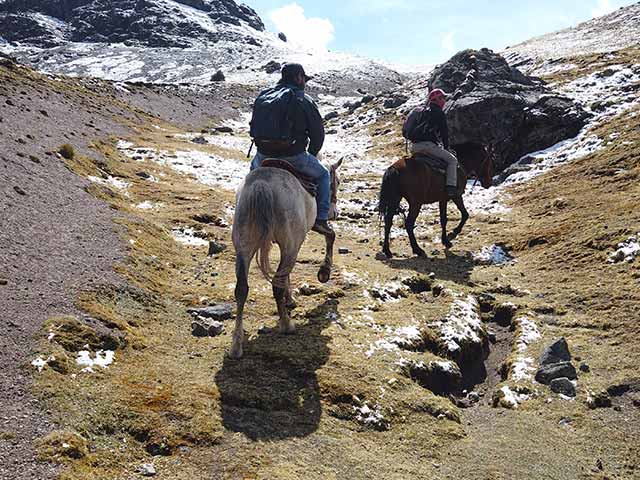
OUR MULEETERS AND HORSES
Our experienced muleteers and their faithful horses are responsible for all our equipment and will always be available in the safe and comfortable camps, ready to receive us.
Faqs
The Inca Trail is a trekking route built by the Inca Empire more than 500 years ago that ends at the famous citadel of Machu Picchu. Along the route you can find countless Inca archaeological remains, such as towers, water sources, platforms, observatories, temples, homes and the Inca Trail itself, whose roads or paths are built with stone.
It is considered one of the best short walks or treks in the world.
The total length of the Inca Trail is approximately 43 kilometers. This route has sections in which you must climb extensive stairs, as well as descend steep hills, so the route is not linear or straight at almost any point.
The walking time during the Inca Trail depends on the distance between the points or camping sites assigned by the INC (National Institute of Culture of Peru, the body in charge of caring for this route) and the physical condition of the traveler. Normally you have between five to eight hours of walking on the first three days and two to three hours of walking on the fourth day.
The porters carry the shared luggage of the trekking group, that is, they carry the tents, blankets, food, kitchens, utensils and other belongings that will probably be used during the tour by all participants.
Each traveler must carry their own backpack containing products for personal use, water, sunscreen, hats, hiking sticks, ponchos or raincoats , etc., up to a maximum of five kilos. This will be verified at the beginning of the tour (the backpacks will be weighed to verify that they do not exceed five kg)
Most of the route is along the road made by the Incas, which is a road or path 1.5 to 15 meters wide so there are no great dangers if you are careful; However, you should not go off the route because there are also deep abysses that are most likely fatal.
If you have heart problems or illnesses that may require immediate medical assistance, you should consult with your doctor because one of the main characteristics of the route is its inaccessibility.
Toilets have been installed along the route and many of them have water facilities, however, most of them are ‘silo’ type toilets which is basically a hole in the ground over which a small room for the bathroom.
The INC (National Institute of Culture of Peru) has assigned specific areas where tourism agencies and operators, through their official guides, set up their camps to spend the night. The traveler only has to worry about his belongings.
The Inca Trail does not require any special skills, that is, you do not need to know how to climb, know how to rappel down and things like that, so any traveler with good boots and good equipment can do it, however, during the The first day of the route is walked from 2,000 meters above sea level to 4,000 meters above sea level, so the physical challenge is considered moderate to intense and a fair to good physical condition is required.
After four days of hiking through impressive and beautiful mountain ranges, valleys and plains, the Inca Trail ends at the Inca citadel of Machu Picchu, the perfect ending to an unforgettable experience.
The final stretch of the Inca Trail ends at the archaeological site known as ‘Inti Punku’ or gate of the sun in Quechua, which is also part of the Machu Picchu Archaeological Park.
The maximum number of tourists or travelers allowed per group is sixteen people, while the minimum group size allowed is four people.
The INC does not require the purchase of insurance to be able to make the trip, however, it would be a very important option if you want to reduce risks.
Since 2001 it has not been possible to do the Inca Trail without the company of an official tourist guide.
The Inca Trail must be done in the company of a group of travelers led by an official tourism guide, who in turn is controlled by the tourism agency or operator.
There are no restrictions regarding the minimum age to do the Inca Trail; If the child is used to walking, he can do this trekking route; however, it would be prudent to communicate and coordinate his entry with the tourism agency.
It is generally recommended that walkers set their own pace, there will normally be groups that complete the route before others, as well as groups that overtake others and then fall behind, so there is no reason to get extremely agitated.
Official tour guides are trained to handle all types of situations, from discomfort due to altitude to fatigue to falls, bumps and sprains. They will do everything possible so that you can complete your journey without problems, but if this is the case they will be responsible for coordinating your return.
Travel Guide
Archaeological Sites within the Inca Trail
Salapunku
The first archaeological site after Km 82 is only visible from the other side of the river; Inca Trail hikers will not visit this site. Travelers can only take photos from the other side of the river. The site has large walls and a large gate that is believed to be the entrance to Machu Picchu from the Sacred Valley.
K’anabamba
Also, Located on the opposite side of the river from the Inca Trail, this second archaeological site was a resting place for travelers.
Llaqtapata: “We found evidence that some Inca chief had built his house here and included ten or dozens of buildings in the plan. They were made of rough stones set in clay with the usual symmetrical arrangement of doors and niches. It may have been built by one of the captains of Manco” – Hiram Bingham, The Lost City of the Incas, 1912.
Willkarakay
Located in the upper part of Llaqtapata, with a circular construction and excellent location, it is noted that it was used and uninhabited by religious priests.
Runkuraka
Located in the heart of the Inca Trail, the semicircular-shaped ruins were once used as a rest stop for more messengers and a religious place for the moon.
Sayakmarca
It is an incredible archaeological site with a strategic location that controls all the cloud forest valleys below. This place was used for religious and military purposes.
Conchamarka
Located just below Sayacmarka, it was probably the home of an important person or a high priest.
Phuyupatamarca: “The city above the clouds” is located on a mountaintop above Machu Picchu Mountain. This place was an important religious place because of the water and the mountains.
Intipata
Located in the thick cloud forest, this site was an important agricultural center. The terraces adapt perfectly to the shape of the mountain.
Wiñayhuayna
This is one of the most beautiful and important Inca sites on the Inca Trail. A religious place with temples, water sources and cultivation terraces.
Intipunku
Sungate, this incredible place, is a checkpoint and an astronomical observatory. The first and best view of Machu Picchu.
Machu Picchu: There is no greater joy than arriving from the Inca Trail to Machu Picchu.
Prevention of altitude sickness
If you’re one of the lucky few, you won’t feel a thing. There are those whose hearts will beat faster while others may experience difficulty breathing. You may also have nausea or a headache. Don’t risk it; You should prepare for that if it’s your first time in this place.
The best thing you can do is give yourself at least two days to acclimatize before hiking the Inca Trail. Take some medicine, drink coca tea and sleep a lot. It would be best if you buy Diamox to use before you start walking.
You do not need a prescription to buy Diamox in Peru; You can find it in all pharmacies in Cusco; you should order ACETAZOLAMIDE – Acetazolamide (brand name: Diamox), of course, you are expected to feel some common side effects such as dizziness, lightheadedness, tingling sensation. It is best to take it at night before bed or early in the morning before your activities.
If you prefer something more natural, we recommend Sorojchi Pills, Altivital and coca tea, and drink plenty of water.
Self-preparation before the hike
Although it is very fun, it is not that easy. You have to prepare physically and psychologically. You need stamina and stamina, so if you could exercise to improve strength and breathing, it would be pretty easy. Consider running or other cardiovascular exercises. Other top tips are to breathe deeply, take small steps, stay positive, and rent hiking poles.
Almost all hikes on Cusco to Machu Picchu trips will include passing through high altitude sites of at least over 4,000 meters (13,123 feet) before reaching Peru, taking short hikes regularly once a week more.
You can tailor our tours to your preferences, and they re available every day of the year! Our team of travel experts is here to assist you with enthusiasm.


 5 (12 reviews)


