The Inca Trail has been on my must-visit list for ages. I’m dying to follow the legendary route that the ancient Inca once trekked deep into Peru’s Andean Mountains. This all-inclusive four-day hike cuts through incredibly diverse landscapes, leading you to the iconic Machu Picchu. Along the way, you’ll hike through high-altitude passes, wander through lush cloud forests, and get mind-blowing views of snow-capped peaks. You’ll also get your history fix exploring archaeological sites along the way. I can’t wait to follow in the footsteps of the Incas, traversing rugged terrain and walking along ancient stone paths. Passing through sites like Wiñay Wayna and finally reaching the Sun Gate to witness that epic sunrise over Machu Picchu—a UNESCO World Heritage Site and one of the New Seven Wonders of the World—is the ultimate excursion. This journey combines adventure and cultural immersion in a perfect package.
Permit Availability
Permits for the 4-day Inca Trail are selling out incredibly fast. June, July, August, and September are already gone for 2025, and October is moving quickly. You’ve got to book these as soon as possible because availability is limited.
This information was last updated on June 26th, 2025. It’s highly recommended to reserve your permits as soon as you can.
There’s a reason because has been nudging its way to the top of my list. Their planned journey offers a culturally immersive experience through one of the world’s most iconic trekking routes. I’m confident I’ll benefit from their experienced tour leaders, who will teach me all about the rich history and archaeology of the trail, adding so much depth to the experience. Their commitment to sustainable tourism means minimal environmental impact and support for local communities. They handle all the logistics, permits, campsites, and meals, which means I can focus all my energy on enjoying the breathtaking scenery and the trail’s historical significance. From the mesmerizing ruins of Machu Picchu to the rugged beauty of the Andes, this trip promises an unforgettable adventure that blends exploration, education, and responsible travel.
Our journey kicks off with an early pickup. The team will grab me from my hotel in Cusco (11,155 ft / 3,400 m) at 4:30 AM. If you’re in the Sacred Valley, the pickup is between 6:00 and 6:30 AM. We’ll drive for about 90 minutes to Ollantaytambo (9,160 ft / 2,792 m) for an included breakfast. Then, we continue to Piskacuchu (Km 82), the official start of the Inca Trail, where we’ll meet our team of porters. After passing the checkpoint and crossing the Urubamba River, the trekking begins.
The first section is mostly flat until we hit a rest area called Mesqay. After Mesqay, there’s a short, steep five-minute section—a preview of what’s to come tomorrow. We’ll then visit the Inca site of Willkarakay and get a great view of the major archaeological site of Llactapata. From there, we’ll hike to Hatunchaca for a tasty lunch. After lunch, we’ll hike for about 45 minutes to Wayllabamba (9,514 ft / 2,900 m), the last village on the trail. You can grab any last-minute snacks or batteries here. After that, it’s a 90-minute uphill hike to our campsite at Ayapata (10,828 ft / 3,303 m), where our porters will have the camp set up. We’ll have dinner and get some rest for the big day ahead.
Today is the most challenging part of the trek. We’ll wake up early with a cup of coca tea and have breakfast before we start hiking to take advantage of the cool morning air. The trail gets steeper on the way to the Llulluchapampa (12,467 ft / 3,800 m) rest stop, which takes about 90 minutes. This is your last chance to buy water or snacks, as there are no more shops after this point.
After resting, we’ll continue for about two hours towards Dead Woman’s Pass (13,779 ft / 4,200 m). As we climb, the landscape changes from lush greenery to open highlands, and the view from the top is absolutely stunning. We’ll get a real sense of the different microclimates and ecological zones of the region. After reaching the top, we’ll hike downhill for about two hours to Pacaymayo (11,800 ft / 3,600 m) for lunch.
After lunch, we’ll hike uphill again for about two hours to the Runkurakay Pass (13,763 ft / 4,195 m), the second-highest point of the expedition. We’ll stop at the Runcu Rakay Inca site for an explanation. After crossing the pass, we’ll descend to Sayacmarca (11,811 ft / 3,600 m) for a tour before walking another 20 minutes to our campsite at Chaquicocha (11,646 ft / 3,550 m). After dinner, if you’ve got the energy, we can enjoy some stargazing and learn about Inca constellations under the pristine Southern Hemisphere sky.
Today is a highlight because we get to see hidden archaeological sites that are only accessible on these guided Inca Trail tours. We’ll start the day with a healthy breakfast before we hike from Chaquicocha to Phuyupatamarca (11,981 ft / 3,652 m). The first part is known as the “Peruvian flat,” a mix of uphill and downhill sections. We’ll hike for about two hours through beautiful scenery, spotting colorful orchids and maybe some unique wildlife. On our left, we’ll have incredible views of the Salkantay Glacier.
Reaching Phuyupatamarca, we’ll be rewarded with stunning views of the Urubamba River and Machu Picchu Mountain—though the ruins will still be hidden. From there, the trail descends for about three hours through the rainforest until we reach Intipata (9,186 ft / 2,800 m). We’ll visit the famous Inca sites of Phuyupatamarca and Intipata along the way. We’ll end the day at our campsite near the Wiñay Wayna (8,789 ft / 2,679 m) archaeological site. After lunch, you’ll have free time to rest or explore. Later, we’ll visit Wiñay Wayna, considered one of the most beautiful spots on the entire trail. In the evening, we’ll thank our porters and cook for all their help.
Today is the day! After an early breakfast, we’ll start the final push to the lost city of Machu Picchu (7,972 ft / 2,430 m). We’ll check in at the control center early in the morning and then hike to the Sun Gate (Inti Punku). From here, we’ll get our first breathtaking view of Machu Picchu in all its glory. After taking in the view, we’ll hike for about 45 minutes to the citadel.
Upon arrival, we’ll enter the site and follow Circuit 1, which gives you the perfect panoramic viewpoint for photos. We’ll then head down to the checkpoint to register and use the restroom before re-entering the site. After that, we’ll enjoy a private two-hour guided tour on Circuit 3, visiting landmarks like the Temple of the Sun, the Water Fountains, the Sacred Rock, and the Temple of the Condor. After the tour, we’ll take the bus down to Aguas Calientes (7,871 ft / 2,401 m) for lunch and some time to relax and explore the town. Then, we’ll board the train back to Ollantaytambo, arriving around 7:00 p.m. This is the end of our unforgettable Inca Trail journey.
Note: Campsite locations may change depending on availability.
Additional Options
| Option | Cost |
| Huayna Picchu Mountain | $65 |
| Vistadome Upgrade | $50 |
| Sleeping Bag Rental | $20 |
| Walking Stick Rental | $20 |
| Air Mattress Rental | $20 |
Essentials
Clothing and Footwear
Toiletries
Huayna Picchu Mountain: This peak, which serves as the backdrop to Machu Picchu, offers incredible views from the top. We handle the ticketing to secure your desired date and time. The hike is scheduled after your guided tour of Machu Picchu. You’ll enter around 10:40 AM for an unguided hike. It takes about an hour to reach the top and 45 minutes to descend. The whole experience lasts about 2-2.5 hours, and you’ll be back in Machu Picchu by 1:00 PM for the bus. Some sections of the trail are steep and require using handholds, so it isn’t ideal for those with a fear of heights.
Vistadome Upgrade: Your Inca Trail journey includes a ticket on the Expedition Train, which is comfortable and clean. However, you can upgrade to the Vistadome Train for your return trip from Aguas Calientes to Ollantaytambo. The Vistadome has larger windows and a glass roof, perfect for taking in the incredible mountain views. It also offers entertainment, dance performances, and a complimentary snack.
Trekking Poles: We highly recommend trekking poles, given the varied terrain with stone steps, hills, and descents. They offer significant support and stability, which helps prevent injuries. You can hire high-quality Black Diamond poles from us for $20 for the entire trek. They’re especially useful if you have knee issues or are new to hiking.
Sleeping Bag: If you don’t want to bring your own, you can rent a high-quality Mountain Hardware sleeping bag from us for $20 for the entire trek. They’re tested to handle temperatures as low as -20°C, which is useful on the second night.
Air Mattress: We provide a comfortable foam mattress, but you can add an inflatable air mattress for an extra $20 for even more comfort and a better night’s rest.
A highly qualified professional with extensive experience in the art of guiding will lead your tour. They have years of dedication to nature walks, have medical certifications and an overflowing passion for leading people on unforgettable adventures.
We understand how essential a delicious hot meal is to revitalize and comfort your body after a challenging hike. Therefore, on each expedition with Ausangate Peru, you will find chefs with extensive experience in preparing meals during the hikes.
All our hiking trips offer a varied selection of delicious meals, rich in carbohydrates, proteins and essential fats. We have carefully selected foods that adapt perfectly to the natural environment.
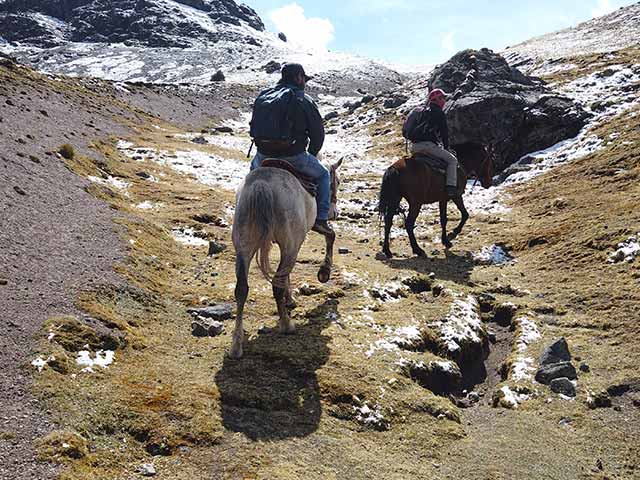
Our experienced muleteers and their faithful horses are responsible for all our equipment and will always be available in the safe and comfortable camps, ready to receive us.
The Inca Trail is a trekking route built by the Inca Empire more than 500 years ago that ends at the famous citadel of Machu Picchu. Along the route you can find countless Inca archaeological remains, such as towers, water sources, platforms, observatories, temples, homes and the Inca Trail itself, whose roads or paths are built with stone.
It is considered one of the best short walks or treks in the world.
The total length of the Inca Trail is approximately 43 kilometers. This route has sections in which you must climb extensive stairs, as well as descend steep hills, so the route is not linear or straight at almost any point.
The walking time during the Inca Trail depends on the distance between the points or camping sites assigned by the INC (National Institute of Culture of Peru, the body in charge of caring for this route) and the physical condition of the traveler. Normally you have between five to eight hours of walking on the first three days and two to three hours of walking on the fourth day.
The porters carry the shared luggage of the trekking group, that is, they carry the tents, blankets, food, kitchens, utensils and other belongings that will probably be used during the tour by all participants.
Each traveler must carry their own backpack containing products for personal use, water, sunscreen, hats, hiking sticks, ponchos or raincoats , etc., up to a maximum of five kilos. This will be verified at the beginning of the tour (the backpacks will be weighed to verify that they do not exceed five kg)
Most of the route is along the road made by the Incas, which is a road or path 1.5 to 15 meters wide so there are no great dangers if you are careful; However, you should not go off the route because there are also deep abysses that are most likely fatal.
If you have heart problems or illnesses that may require immediate medical assistance, you should consult with your doctor because one of the main characteristics of the route is its inaccessibility.
Toilets have been installed along the route and many of them have water facilities, however, most of them are ‘silo’ type toilets which is basically a hole in the ground over which a small room for the bathroom.
The INC (National Institute of Culture of Peru) has assigned specific areas where tourism agencies and operators, through their official guides, set up their camps to spend the night. The traveler only has to worry about his belongings.
The Inca Trail does not require any special skills, that is, you do not need to know how to climb, know how to rappel down and things like that, so any traveler with good boots and good equipment can do it, however, during the The first day of the route is walked from 2,000 meters above sea level to 4,000 meters above sea level, so the physical challenge is considered moderate to intense and a fair to good physical condition is required.
After four days of hiking through impressive and beautiful mountain ranges, valleys and plains, the Inca Trail ends at the Inca citadel of Machu Picchu, the perfect ending to an unforgettable experience.
The final stretch of the Inca Trail ends at the archaeological site known as ‘Inti Punku’ or gate of the sun in Quechua, which is also part of the Machu Picchu Archaeological Park.
The maximum number of tourists or travelers allowed per group is sixteen people, while the minimum group size allowed is four people.
The INC does not require the purchase of insurance to be able to make the trip, however, it would be a very important option if you want to reduce risks.
Since 2001 it has not been possible to do the Inca Trail without the company of an official tourist guide.
The Inca Trail must be done in the company of a group of travelers led by an official tourism guide, who in turn is controlled by the tourism agency or operator.
There are no restrictions regarding the minimum age to do the Inca Trail; If the child is used to walking, he can do this trekking route; however, it would be prudent to communicate and coordinate his entry with the tourism agency.
It is generally recommended that walkers set their own pace, there will normally be groups that complete the route before others, as well as groups that overtake others and then fall behind, so there is no reason to get extremely agitated.
Official tour guides are trained to handle all types of situations, from discomfort due to altitude to fatigue to falls, bumps and sprains. They will do everything possible so that you can complete your journey without problems, but if this is the case they will be responsible for coordinating your return.
The first archaeological site after Km 82 is only visible from the other side of the river; Inca Trail hikers will not visit this site. Travelers can only take photos from the other side of the river. The site has large walls and a large gate that is believed to be the entrance to Machu Picchu from the Sacred Valley.
Also, Located on the opposite side of the river from the Inca Trail, this second archaeological site was a resting place for travelers.
Llaqtapata: “We found evidence that some Inca chief had built his house here and included ten or dozens of buildings in the plan. They were made of rough stones set in clay with the usual symmetrical arrangement of doors and niches. It may have been built by one of the captains of Manco” – Hiram Bingham, The Lost City of the Incas, 1912.
Located in the upper part of Llaqtapata, with a circular construction and excellent location, it is noted that it was used and uninhabited by religious priests.
Located in the heart of the Inca Trail, the semicircular-shaped ruins were once used as a rest stop for more messengers and a religious place for the moon.
It is an incredible archaeological site with a strategic location that controls all the cloud forest valleys below. This place was used for religious and military purposes.
Located just below Sayacmarka, it was probably the home of an important person or a high priest.
Phuyupatamarca: “The city above the clouds” is located on a mountaintop above Machu Picchu Mountain. This place was an important religious place because of the water and the mountains.
Located in the thick cloud forest, this site was an important agricultural center. The terraces adapt perfectly to the shape of the mountain.
This is one of the most beautiful and important Inca sites on the Inca Trail. A religious place with temples, water sources and cultivation terraces.
Sungate, this incredible place, is a checkpoint and an astronomical observatory. The first and best view of Machu Picchu.
Machu Picchu: There is no greater joy than arriving from the Inca Trail to Machu Picchu.
If you’re one of the lucky few, you won’t feel a thing. There are those whose hearts will beat faster while others may experience difficulty breathing. You may also have nausea or a headache. Don’t risk it; You should prepare for that if it’s your first time in this place.
The best thing you can do is give yourself at least two days to acclimatize before hiking the Inca Trail. Take some medicine, drink coca tea and sleep a lot. It would be best if you buy Diamox to use before you start walking.
You do not need a prescription to buy Diamox in Peru; You can find it in all pharmacies in Cusco; you should order ACETAZOLAMIDE – Acetazolamide (brand name: Diamox), of course, you are expected to feel some common side effects such as dizziness, lightheadedness, tingling sensation. It is best to take it at night before bed or early in the morning before your activities.
If you prefer something more natural, we recommend Sorojchi Pills, Altivital and coca tea, and drink plenty of water.
Although it is very fun, it is not that easy. You have to prepare physically and psychologically. You need stamina and stamina, so if you could exercise to improve strength and breathing, it would be pretty easy. Consider running or other cardiovascular exercises. Other top tips are to breathe deeply, take small steps, stay positive, and rent hiking poles.
Almost all hikes on Cusco to Machu Picchu trips will include passing through high altitude sites of at least over 4,000 meters (13,123 feet) before reaching Peru, taking short hikes regularly once a week more.