While everyone talks about the big-name Inca sites, there’s a place that has firmly nudged its way to the top of my hit list: Huchuy Qosqo, the ‘Little Cusco.’ This isn’t about ticking a box; it’s about a craving for a real adventure to a place that still feels like a secret. The very idea of it—a hidden city perched high in the Sacred Valley, once a private refuge for Inca nobility—is impossibly romantic. I’m desperate to see its unique architecture, where flawlessly polished stone meets rustic adobe, a style that whispers of an even more ancient past than its famous neighbors. This trek feels like a journey back in time, a chance to walk paths less traveled and connect with the wild, dramatic heart of the Andes.
The day I’m planning would kick off early, with a pickup from my hotel in Cusco (elevation: 3,399 m / 11,152 ft) between 6:30 and 7:00 AM. After a quick briefing with the guide, we’ll head out. The journey itself is part of the appeal, a scenic drive towards the village of Chinchero (elevation: 3,762 m / 12,343 ft). I can already picture the views over vast, ancient farmlands and the shimmering waters of the Piuray Lagoon.
Our starting point for the hike is the community of Tauca. This is where the real work begins. We’ll follow a dirt path that slopes gently at first, leading us toward the Pucajasa pass. At a breathtaking 4,393 meters (14,413 ft), this is the highest point of the trek. I can’t wait for that moment—standing on the 200-meter-long pass, catching my breath, and being rewarded with what I’m told is a spectacular, panoramic view of the entire Urubamba mountain range.
From that high point, the descent begins. This is where I hope to get my history fix, spotting original sections of ancient Inca trails and watching as the entire ecosystem changes around me. The anticipation will be immense as we finally approach Huchuy Qosqo (elevation: 3,688 m / 12,099 ft). Here, we’ll break for a snack and then I’ll finally get to explore the archaeological complex I’ve been dreaming of.
After a thorough exploration, the journey continues with a final descent to the village of Lamay (elevation: 2,938 m / 9,639 ft), where a well-earned lunch will be waiting. With a full stomach and a camera full of memories, we’ll hop in our private transport for the ride back to Cusco, planning to arrive back at the hotel around 6:00 PM, ending an absolutely epic day.
A highly qualified professional with extensive experience in the art of guiding will lead your tour. They have years of dedication to nature walks, have medical certifications and an overflowing passion for leading people on unforgettable adventures.
We understand how essential a delicious hot meal is to revitalize and comfort your body after a challenging hike. Therefore, on each expedition with Ausangate Peru, you will find chefs with extensive experience in preparing meals during the hikes.
All our hiking trips offer a varied selection of delicious meals, rich in carbohydrates, proteins and essential fats. We have carefully selected foods that adapt perfectly to the natural environment.
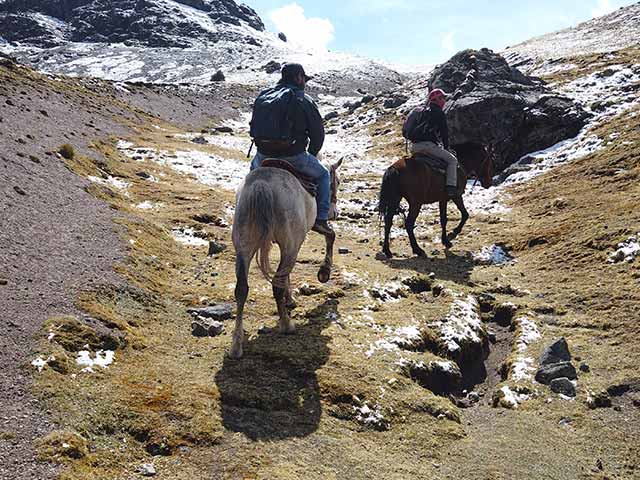
Our experienced muleteers and their faithful horses are responsible for all our equipment and will always be available in the safe and comfortable camps, ready to receive us.
The best season is definitely the dry season, which runs from April to October. During these months, the skies are clearer, and you’ll get the most stunning views. In the rainy season, the trails can be muddy, and the site is often shrouded in clouds, which would be a shame after that hike!
It’s a valid concern. The altitudes on this trek are higher than in Cusco, reaching up to 4,400 meters. The absolute best way to avoid altitude sickness is to give yourself at least one or two days to acclimatize in Cusco before you go. Take it easy, walk around the city, and don’t do anything too strenuous.
The altitudes change quite a bit throughout the day. Here’s a quick breakdown: